Sermon-Jesus is the Sower of Seed
Published on Thursday, October 22, 2026
The Reading from Galatians 1:11-19 The Reading from St. Luke 8:5-15
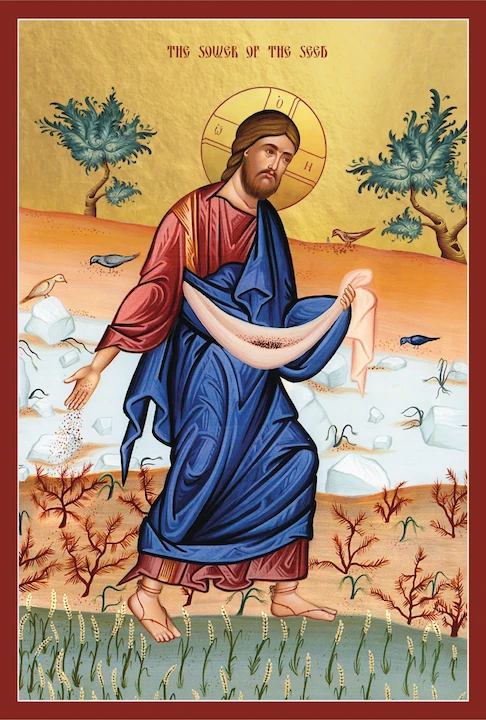
Once again we reach the parables in the Gospel of St. Luke, and we are reminded by these parables of some very important things.
The parables of Christ teach us about the mystery of The Kingdom of God, the mystery of The Church, the mystery of repentance and sanctification.
And today we have the Parable of the Sower, the seed spreader, the planter of seeds, the sea.
This teaches us about Christ, who is the Great Sower. It teaches us about the Church, those whom have become seeds that sprouted.
It teaches us about the radical, maniacal love of God for all mankind.
Indeed, notice that Christ distributes seed liberally, as if there was no end to seed to be sown.
He spreads it indiscriminately, abundantly. He is not willing that any should perish but that all should have eternal life.
This is John 3:16-God loved the whole world so much He is intending to save everyone. That His love is readily available.
Not just to the elect but to all mankind.
How many of us in this church today can testify to the Sower planting a seed in your heart that is now growing into a fruit bearing plant?
The Great Sower of the Seed is working and has never stopped working, all over the globe.
This is why He uses the illustration of fishers of men. He casts His net wanting to catch an abundant catch, one that is so large it is hard to bring in, .Yet the net is not torn.
Holy elders of Mt. Athos have reportedly stated decades ago that “The next great flowering of Orthodoxy will be in America.”
Many holy elders (holy elders are men and women) have great reverence for St. Herman of Alaska and his saintly life, saying he was so faithful in bringing the Faith to North America.
This has been building for a few hundred years.
Even as the Russian Orthodox Church was been systematically devasted by the God hating communists, the Church was being established in America.
These was a time in the earlier times of the 20th Century when Mt. Athos itself was in decline.
But Sts. Silouan, Nektarios, and others began to re-ignite the prayer of the heart and this caused a revival on the Holy Mountain which is continuing today.
How marvelous that God is patient, not in a hurry.
How marvelous that the gates of hades will not prevail over the Church of Jesus Christ.
Not only does the sower plant seeds, He also nourishes them into plants.
We are the beneficiaries of the fervent love God has for all the human race.
The astonishing growth of the Orthodox Church in North America is not a sudden thing. It has been prayed into existence over hundreds of years.
God arranges timing, He prepares fertile soul. He plants seeds. He sends gentle rain, sun, nourishment. He restrains pests who want to destroy the Garden.
We were spending many decades in the Orthodox Church thinking we were always going to be the “best kept secret in America.”
But God has a better idea. He has the resources. He has a long term plan.
We, you and I, are the fulfillment and fruit of this plan.
We have been caught in His net, we are becoming fruit bearing plants.
We are a generation that must help spread the word with the fruit we are bearing.
Here is a story I recently read about this. This is not my story, but hear the encouragement in it. I quote what he wrote.
“My spiritual father was living in Greece quite a few years ago and was told by the bishop that he was going to be sent back to America, his birthplace.
My spiritual father had an entire life in Greece, so moving back to America wasn’t really on his bucket list, and so the first thing he did was go to his own spiritual father, Elder Paisios, to discuss the move. Elder Paisios said something curious:
“America is going to be the yeast in Orthodox Christianity.”
My spiritual father was surprised at this statement because, although he was born in the USA, he never thought much of the country. Americans seemed uninterested in Christianity.
He then traveled across the country and met with his other spiritual father, Saint Porphyrios, who quite literally said the exact same thing, using the very words of Elder Paisios:
“America is going to be the yeast in the Orthodox Church.”
These words, spoken by two very holy men of the last century, could not have been more strange to an Orthodox priest whose experience of Orthodox Christianity was rather similar to my own in the 1970s and ’80s in America.
Most Americans had no interest in the ancient faith, and other than a very small group of evangelical churches in the late ’80s who converted to Orthodox Christianity, by and large, American Christians seemed far more interested in the latest worship trends than in coming to a church that encourages humility, fasting, and learning to sit in silence before God.
My spiritual father’s first stop in North America was Windsor, Canada, where he spent two years or so, and baptized more than 500 adult converts to the faith. Which is rather remarkable. As this was long before this recent surge of interest in Orthodox Christianity. He himself was shocked. He has told me many times over:
“I was praying the same prayers I prayed in Greece, I was doing nothing different, but suddenly every week I was seeing miracles happen, people being healed, and people wanting to become baptized.”
This is exactly what happened with Elder Ephraim of Philothea monastery on Mt Athos.
Back in the early 90’s he was the protos of the Holy Mountain, kind of like an archbishop, the chairman of all the monasteries.
He came to Boston for medical treatment and spent some time there.
Many began to come to him for confession, as confession was mostly unknown then in the Greek Orthodox Church of America.
Lines formed around his house as word spread of a holy elder who could heal souls.
He began the practice of traveling around teaching priests about confession and hearing thousands of confessions of priests and lay people.
After this went on for a few years the other elders of Mt. Athos told the Holy Elder Ephraim to make a choice, either be here, or there.
He was determined to move to America, being given a commission to establish monasteries in North America.
He established 17 monasteries in America and Canada!
This had a significant impact on America and the Orthodox churches here.
This is the Sower working in our lives, being a good gardener.
Finding fertile soil, it was planted and nourished.
These are reasons for the recent explosion of growth in Orthodoxy.
COVID is another huge contributor.
All over North America Orthodox Churches are being overwhelmed with converts and reverts.
We are all searching for new property, larger churches, catechism help.
We are the seeds the Sower has planted here in Venice.
So where do we go from here?
1. We recognize what is happening. What are we part of?
2. We understand that this is not because of our own effort, but the work of God in the Holy Spirit. He blesses our efforts, He multiplies our efforts, He is the one who is drawing all these people to come to the Church.
We remain faithful to our calling here in this small parish, we become like a lighthouse to Venice. We are a shelter and retreat from the darkness, a place of healing.
3. We ask ourselves, do I have ears to hear?
Am I answering the call of the Sower to bear fruit, the fruits of repentance, a changed life?
In this parable our Lord describes the heart with an analogy of soil. Good soil bears much fruit because it is cooperating with the gardener.
Are we part of this cooperation? Are we helping the Gardener? Or to use another analogy from the Lord Jesus, the parable of the vineyard, are drawing nutrition from the vine.
He is the vine, we are branches of the vineyard.
As long as we are attached to the vineyard we will bear fruit.
What does this fruit look like? It look like the Saints, like St. Paisios and Porphyrios, St. Herman, like the Theotokos.
The fruit looks like holiness. It looks like Christ.
We are not here for any other reason other than to become like Him, to become saints.
The Church makes saints, relics. It has an aroma of holiness.
Can you smell it?