
Sermon-Rich Man and Lazarus-October 25
Published on Sunday, October 25, 2026
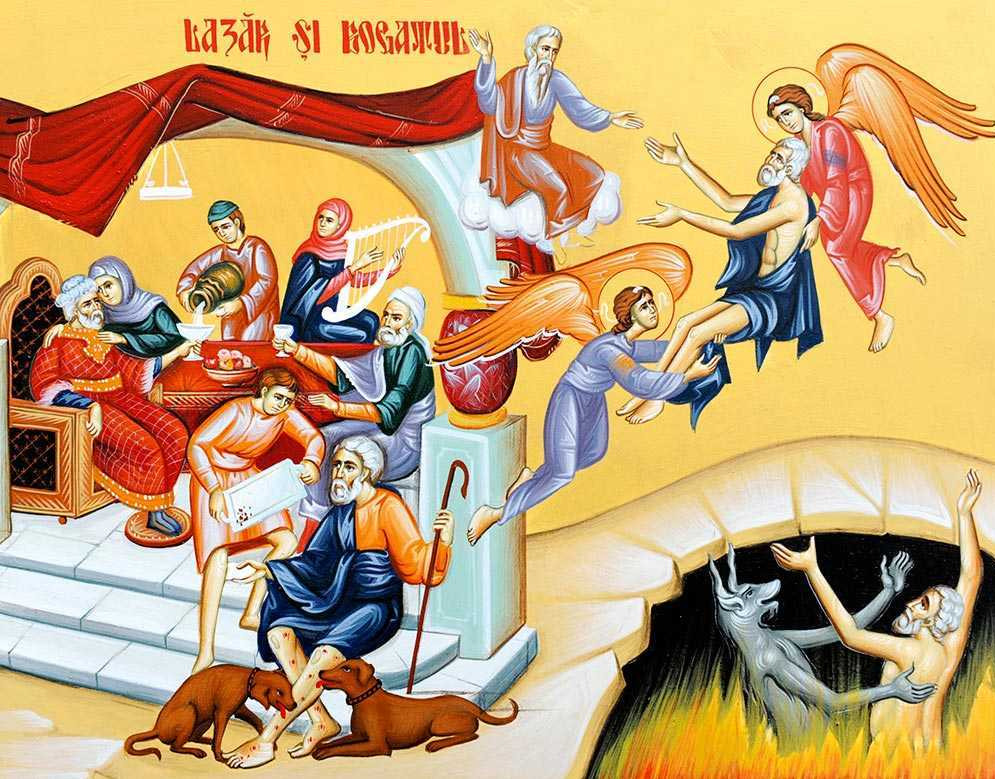
Today, we read the famous teaching from St. Luke’s Gospel about the beggar Lazarus and the rich man.
It was no accident that Lazarus was laid at this rich man’s gate. God knew that if the rich man could open his heart just a tiny bit, give alms just once – that little gap in his cold heart would create an opening for more of God’s love and grace to enter.
God is creative in his salvific ways. He doesn’t need much – just the tiniest speck of goodness, the littlest inclination to do something good, and He comes rushing in with His grace, beginning salvation in our hearts.
Every day the poor Lazarus laid near the rich man’s front door, wasting away, being harassed by animals, starving to death. And every day the rich man’s heart grew colder and further from God.
It’s as if God said, “If he will just show mercy one time, then I will have something to work with.” But the rich man refused. He remained absorbed in himself, his own cares, his luxuries, and he disdained the poor Lazarus at his door.
Even after the rich man’s death, there is no change of heart. He does not regret his lack of mercy but begins demanding that Lazarus serve him, bringing him water while he burns in Hades. When that doesn’t work, he again demands the service of Lazarus, that he be sent to warn the rich man’s family.
Even in Hades, the rich man views himself as superior to Lazarus. His heart has not changed in torments, he simply longs for his old luxuries and comfort.
We hear these things and we must ask ourselves sobering questions: who or what is the Lazarus that God has sent into my life? What people, situations, or circumstances have been sent my way to get me out of my own head, to get me to pay attention to the needs of others? What is my heart like? Am I like this rich man?
Who rubs me the “wrong” way in order to get me to see that I am the one who lacks mercy?
The parable presents us with the two extremes of wealth and poverty. It shows us the dangers of wealth that becomes a love of money, which produces arrogance. And it shows how poverty can make a person truly humble.
One suffers in this life, the other suffers in the next life.
The Fathers of The Church have an insightful way of looking at the early part of the parable about the rich man. It says in verse 22, the rich man died and was buried.
The Fathers see this as an illustration of the state of his miserable soul, buried by the pleasures of the flesh. St. John Chrysostom says: He was already buried in life by ‘couches, rugs, furnishings, sweet oils, perfumes, large quantities of wine, varieties of food and flatterers.’
That the rich man remains unnamed indicates that he is ultimately forgotten.
Now you see why we sing Memory Eternal, for God’s remembrance, not peoples.
A. Abraham’s bosom means heaven. Abraham is mentioned among the righteous because, in stark contrast to the rich man, Abraham showed hospitality to strangers. (Gen. 18:1-8)
B. The great gulf shown in the parable is not one of place or geography, but the complete separation between virtue and wickedness. After dead this gulf cannot be crossed. There is no repentance after death. That is what this life is for.
C. Torments do not change the heart of the rich man, he still regards Lazarus as beneath him, his servant, fit only to give him comfort.
D. This has something to teach us about the communion of the Saints. A man, not even a believer, calls out from Hades and converses with St. Abraham. There is much more here for us to grasp about this other dimension of our lives,
We are so minded that we are barely aware, to say nothing about in touch with, the spiritual world.
We also notice that the rich man, perhaps to develop some compassion, he asks that his family on earth, be told of what awaits them.
This visitation is denied, they already have been told, they have The Scriptures, if they won’t listen to them, they won’t listen to one who rises from the dead, Jesus, (see, Matt. 28:11-15; John 12:9-11)
St. John Chrysostom: ‘the ignorance of scripture is a great cliff and a deep abyss; it is impossible for anyone to be without benefit if he reads continually and with attention.’
God is creatively working out the salvation of each one of us, putting all the pieces in place, masterfully orchestrating the whole thing. But am I paying attention? Do I see my brother Lazarus in my life, whatever that might look like, or am I too absorbed in myself to notice?
How many of us, even though we have the abundant mercy of the Lord through the services of the Church are absent, or neglect to enter into prayer and repentance.?
How will the Lord get through to us, to help us realize how often we neglect our salvation to focus on this world, on pleasure, on comfort, on all the varied distractions of this life, the news, conspiracy theories, rumors?
The Lord Jesus often speaks in parables and very often does not speak directly because he wants the hearer to think about the words he hears. He wants to break through to our understanding.
One might wonder what that rich man did to go to torment. Did he do something evil to Lazarus? He did not harm Lazarus and did not do or say anything to him.
The great mistake or sin that the rich man committed and for which he went to torment is that there was near him, next to him, a poor man and he did not notice him. He did not see him. He took no interest in him! This is what our saints say is our great sin, that we do not notice our brother in need, that we have no feeling for others!
One of the great saints, Saint Isaac the Syrian, says that “the great sin is the lack of sensitivity to sin.”
How many people commit sins and do not feel that they are sinning! In this parable, the rich man did not sense the presence of the poor man “Lazarus” near him. This was his sin: a lack of sensitivity. This is the great sin.
Here on this earth the Lord gives us the opportunity to repent and to confess our sins and if we do not confess we will be held accountable for the actions we have done on this earth.
But the whole point of a parable is to make us think. So let’s stop for a moment and think about it.
The parable doesn’t say that the rich man was wicked and cruel. Perhaps he simply didn’t want to spoil his happy, comfortable life by coming into contact with disease, poverty, and death.
Maybe the rich man, like many of us, see religion as a code of do’s and don’ts.
And what about Lazarus? He lay there, poor, sick, festering with wounds, surrounded by dogs and, as the Gospel says, wanting to be fed with the crumbs that fell from the rich man’s table.
Lazarus lay at the rich man’s gates, possibly for many years. And when he died, angels came for him. They probably came for a reason. But about the rich man it just says that he “was buried.” No angels are mentioned.
Christ expects from us not to only have beauty of soul, but to have specific deeds that would show our faith and our love.
He Himself didn’t distain joining with matter, being born in a stable, and dining with harlots.
He expects the same thing of us: not closing ourselves off, not cordoning ourselves off from “other people’s problems,” but rather actively participating in the lives of those who stand in need of us.
So why did the Lord condemn the rich man? Because he had done something bad? No, because he didn’t do good.
This parable is extremely important for us. We Christians who go to church and regularly have Confession and Communion are, on the whole, good people: we don’t kill, we steal nothing, and we don’t get in each other’s way.
But the Lord didn’t say: “Don’t get in each other’s way.” He said: “Love thy neighbor as thyself.” And our love needs to be active and effective.
We often confuse our financial comfort in this world as being a sign of God’s approval of the way we live and treat others around us. But the Jesus tells us that the Father in heaven “makes His sun rise on the evil and on the good and sends rain on the just and on the unjust” (Matt. 5:45).
In other words, God gives good things to everyone but not everyone uses those blessings for the good of His Kingdom.
In our lesson today, the rich man was not being punished because he was rich. He was in torment because he neglected to use his wealth wisely.
We should never wait until it is too late to change the course of our current and eternal lives.
One of the greatest blessings that we receive as children of God is the opportunity to change our lives and thus change the course of our eternity.
The lives of the holy saints teach us that many of them were terrible sinners, living lives of sinful excess.
But we serve a God of “second chances,” Who gives us the opportunity to repent, receive forgiveness and set our feet onto the path of righteousness.
Jesus’ message should be just as clear to us as it was when He told this parable: “‘If they do not hear Moses and the prophets, neither will they be persuaded though one rise from the dead’” (Luke 16:31).
So, let us heed the warnings from the Church and the Scriptures and change our sinful ways so that we may also receive the blessing of joining the righteous in blessed repose.