Fasting Rules
 Meat
Allowed
 Fish
Allowed
 Dairy
Allowed
 Oil
Allowed
 Wine
Allowed
Saints & Commemorations
St Romanos the Melodist of Constantinople (556)
He was born in Emessa in Syria, probably of Jewish parents. He served as a deacon in Beirut, then in Constantinople at the time of Patriarch Euphemius (490-496). He was illiterate, had no musical training, and was a poor singer; thus he was despised by many of the more cultivated clergy. One night, after Romanos had prayed to the Mother of God, she appeared to him in a dream, held out a piece of paper and told him to swallow it.
He was born in Emessa in Syria, probably of Jewish parents. He served as a deacon in Beirut, then in Constantinople at the time of Patriarch Euphemius (490-496). He was illiterate, had no musical training, and was a poor singer; thus he was despised by many of the more cultivated clergy. One night, after Romanos had prayed to the Mother of God, she appeared to him in a dream, held out a piece of paper and told him to swallow it. On the following day, the Nativity of Christ, Romanos went to the ambon and, with an angelic voice, sang ‘Today the Virgin…’, which is still sung as the Kontakion of the Feast. All present were amazed at the completely unexpected beauty of the hymn and of Romanos’ singing. St Romanos went on to compose more than a thousand Kontakia (which were once long hymns, not the short verses used in church today). He is almost certainly the author of the sublime Akathist Hymn to the Mother of God, which has served as the model for all other Akathists. He reposed in peace, while still a deacon of the Great Church in Constantinople. Many of his hymns were inspired by the hymns of St Ephraim of Syria.
The influence of Middle Eastern music on the hymnography of the Church is incalculable. Many of those who established the form of the Church’s music were Syrians: two noted examples are St Romanos and St John of Damascus, who composed the Octoechos, the Pascha service, and the Funeral Service. Their music was in turn modeled on the music of the Hebrew temple. The Byzantine musical tradition has descended without break from the music sung in Christ’s time, and presumably by Christ Himself.
Our Holy Father Gregory the Choirmaster (Domestikos) of the Great Lavra (1355)
Saint Gregory Domesticus (leading chanter) was the contemporary of Saint John Koukouzelis, and lived in the Great Lavra of Mt. Athos in piety and asceticism. Like Saint John, he also sang in the right choir in the Great Lavra, and was even called Gregory Koukouzelis in honor of his instructor. Saint Gregory was known for his technical skill and for the sweetness of his voice.
Saint Gregory Domesticus (leading chanter) was the contemporary of Saint John Koukouzelis, and lived in the Great Lavra of Mt. Athos in piety and asceticism. Like Saint John, he also sang in the right choir in the Great Lavra, and was even called Gregory Koukouzelis in honor of his instructor. Saint Gregory was known for his technical skill and for the sweetness of his voice. He chanted the Vigil service with great reverence and compunction, never sitting down in church.
Patriarch Callistus I (June 20) had started the practice of singing “All of creation rejoices” at the Liturgy of Saint Basil in place of “It is truly meet....” Patriarch Philotheus (October 8), who succeeded him, restored “It is truly meet” to Saint Basil’s Liturgy. Soon after this Saint Gregory sang “All of creation rejoices” at Liturgy on the eve of Theophany in the presence of Patriarch Gregory of Alexandria. The Most Holy Theotokos appeared to Saint Gregory and thanked him for singing the hymn in her honor. She also handed him a gold coin. From that time forward, “All of creation” has been sung at the Liturgy of Saint Basil.
Saint Gregory fell asleep in the Lord in 1355.
Troparion - Tone 8
By a flood of tears you made the desert fertile, / and your longing for God brought forth fruits in abundance. / By the radiance of miracles you illumined the whole universe! / O our holy father Gregory, pray to Christ our God to save our souls!
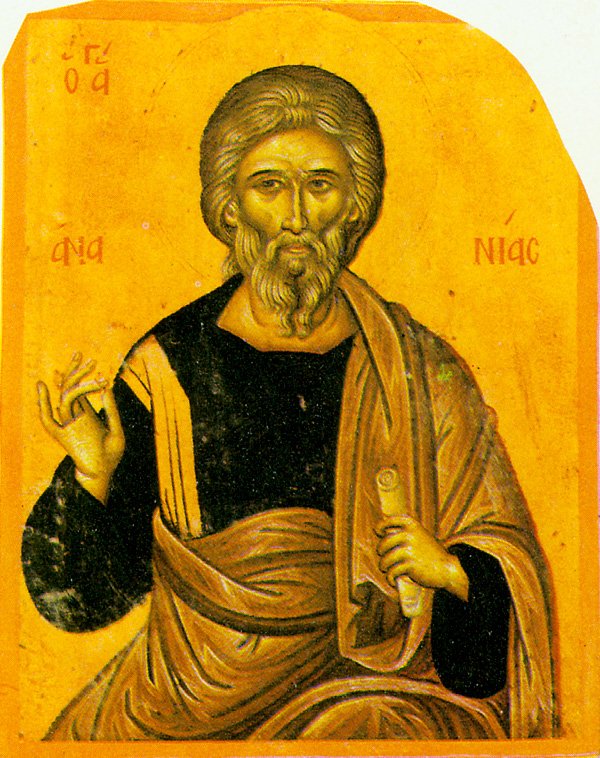
Holy Apostle Ananias of the Seventy
The Holy Apostle Ananias of the Seventy (October 1), was the first Bishop of Damascus. The Lord ordered him to restore the sight of Saul, the former persecutor of Christians, then baptize him (Acts 9:10-19, 22:12). Saul became the great preacher and Apostle Paul. Saint Ananias boldly and openly confessed Christianity before the Jews and the pagans, despite the danger.
The Holy Apostle Ananias of the Seventy (October 1), was the first Bishop of Damascus. The Lord ordered him to restore the sight of Saul, the former persecutor of Christians, then baptize him (Acts 9:10-19, 22:12). Saul became the great preacher and Apostle Paul. Saint Ananias boldly and openly confessed Christianity before the Jews and the pagans, despite the danger.
From Damascus he went to preach at Eleutheropolis, where he healed many of their infirmities. Lucian, the prefect of the city, tried to persuade the holy one to offer sacrifice to idols. Because of Ananias’ staunch and solid confession of Christ, Lucian ordered that he be tortured. Harsh torments did not sway the witness of Truth. Then the torturers led him out beyond the city, where they stoned him. The saint prayed for those who put him to death. His relics were later transferred to Constantinople.
Troparion - Tone 3
Holy Apostle Ananias, / entreat the merciful God, / to grant our souls forgiveness of transgressions.
Saint Remigius, Bishop of Rheims, Apostle to the Franks (533)
He was born in 438 in northern Gaul. After devoting himself for awhile to secular and sacred learning, he withdrew to a small house near Laon, to live in reclusion and prayer. But when a bishop was needed in Rheims, the clergy and people carried him off from his hermitage and made him their bishop. He was only twenty-two years old at the time.
He was born in 438 in northern Gaul. After devoting himself for awhile to secular and sacred learning, he withdrew to a small house near Laon, to live in reclusion and prayer. But when a bishop was needed in Rheims, the clergy and people carried him off from his hermitage and made him their bishop. He was only twenty-two years old at the time.
The holy bishop soon became renowned throughout northern Gaul. He converted heretics, brought Arian heretics back to the Orthodox Faith, and cared for the many who suffered at the hands of barbarian marauders. Wherever he went, miracles attended him. He healed the sick and demonized and once, when a town was on fire, threw himself into the flames and quenched them. Birds would come to his table whenever he ate, and he would share his meal with them.
In 482 the young warrior Clovis became leader of the Frankish tribes in that region. Though he was a pagan, he knew and admired St Remigius, and was married to a Christian, St Clotilde (June 3). Once, when his army faced defeat by the Alemanii, Clovis prayed to ‘the God of Clotilde and Remigius’ and won a great victory. This answer to his prayers convinced him of the truth of the Christian Faith, and he asked St Remigius to instruct him. Two years later he gathered all his chieftains in Rheims to attend his baptism. The baptism was accompanied by many miracles, seen by all in attendance. Two of the king’s sisters and three thousand of his lords and soldiers were baptized at the ceremony. This event is considered the birth of France as a Christian nation.
In great old age, St Remigius went blind, but miraculously recovered his sight. He reposed in peace at the age of 105, immediately after serving the Divine Liturgy.
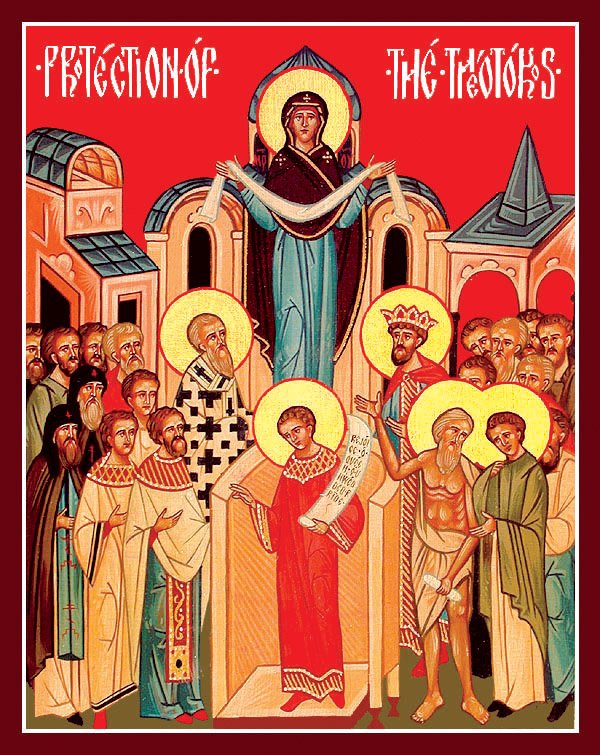
Protection (Pokrov) of the Most-Holy Theotokos
This miraculous appearance of the Mother of God occurred in the mid-tenth century in Constantinople, in the Blachernae church where her robe, veil, and part of her belt were preserved after being transferred from Palestine in the fifth century.
On Sunday, October 1, during the All Night Vigil, when the church was overflowing with those at prayer, the Fool-for-Christ Saint Andrew (October 2), at the fourth hour, lifted up his eyes towards the heavens and beheld our most Holy Lady Theotokos coming through the air, resplendent with heavenly light and surrounded by an assembly of the Saints.
This miraculous appearance of the Mother of God occurred in the mid-tenth century in Constantinople, in the Blachernae church where her robe, veil, and part of her belt were preserved after being transferred from Palestine in the fifth century.
On Sunday, October 1, during the All Night Vigil, when the church was overflowing with those at prayer, the Fool-for-Christ Saint Andrew (October 2), at the fourth hour, lifted up his eyes towards the heavens and beheld our most Holy Lady Theotokos coming through the air, resplendent with heavenly light and surrounded by an assembly of the Saints. Saint John the Baptist and the holy Apostle John the Theologian accompanied the Queen of Heaven. On bended knees the Most Holy Virgin tearfully prayed for Christians for a long time. Then, coming near the Bishop’s Throne, she continued her prayer.
After completing her prayer she took her veil and spread it over the people praying in church, protecting them from enemies both visible and invisible. The Most Holy Lady Theotokos was resplendent with heavenly glory, and the protecting veil in her hands gleamed “more than the rays of the sun.” Saint Andrew gazed trembling at the miraculous vision and he asked his disciple, the blessed Epiphanius standing beside him, “Do you see, brother, the Holy Theotokos, praying for all the world?” Epiphanius answered, “I do see, holy Father, and I am in awe.”
The Ever-Blessed Mother of God implored the Lord Jesus Christ to accept the prayers of all the people calling on His Most Holy Name, and to respond speedily to her intercession, “O Heavenly King, accept all those who pray to You and call on my name for help. Do not let them go away from my icon unheard.”
Saints Andrew and Epiphanius were worthy to see the Mother of God at prayer, and “for a long time observed the Protecting Veil spread over the people and shining with flashes of glory. As long as the Most Holy Theotokos was there, the Protecting Veil was also visible, but with her departure it also became invisible. After taking it with her, she left behind the grace of her visitation.”
At the Blachernae church, the memory of the miraculous appearance of the Mother of God was remembered. In the fourteenth century, the Russian pilgrim and clerk Alexander, saw in the church an icon of the Most Holy Theotokos praying for the world, depicting Saint Andrew in contemplation of her.
The Primary Chronicle of Saint Nestor reflects that the protective intercession of the Mother of God was needed because an attack of a large pagan Russian fleet under the leadership of Askole and Dir. The feast celebrates the divine destruction of the fleet which threatened Constantinople itself, sometime in the years 864-867 or according to the Russian historian Vasiliev, on June 18, 860. Ironically, this Feast is considered more important by the Slavs then by the Greeks.
The Primary Chronicle of Saint Nestor also notes the miraculous deliverance followed an all-night Vigil and the dipping of the garment of the Mother of God into the waters of the sea at the Blachernae church, but does not mention Saints Andrew and Epiphanius and their vision of the Mother of God at prayer. These latter elements, and the beginnings of the celebrating of the Feast of the Protection, seem to postdate Saint Nestor and the Chronicle. A further historical complication might be noted under (October 2) dating Saint Andrew’s death to the year 936.
The year of death might not be quite reliable, or the assertion that he survived to a ripe old age after the vision of his youth, or that his vision involved some later pagan Russian raid which met with the same fate. The suggestion that Saint Andrew was a Slav (or a Scythian according to other sources, such as S. V. Bulgakov) is interesting, but not necessarily accurate. The extent of Slavic expansion and repopulation into Greece is the topic of scholarly disputes.
In the Prologue , a Russian book of the twelfth century, a description of the establishment of the special Feast marking this event states, “For when we heard, we realized how wondrous and merciful was the vision... and it transpired that Your holy Protection should not remain without festal celebration, O Ever-Blessed One!”
Therefore, in the festal celebration of the Protection of the Mother of God, the Russian Church sings, “With the choirs of the Angels, O Sovereign Lady, with the venerable and glorious prophets, with the First-Ranked Apostles and with the Hieromartyrs and Hierarchs, pray for us sinners, glorifying the Feast of your Protection in the Russian Land.” Moreover, it would seem that Saint Andrew, contemplating the miraculous vision was a Slav, was taken captive, and became the slave of the local inhabitant of Constantinople named Theognostus.
Churches in honor of the Protection of the Mother of God began to appear in Russia in the twelfth century. Widely known for its architectural merit is the temple of the Protection at Nerl, which was built in the year 1165 by holy Prince Andrew Bogoliubsky. The efforts of this holy prince also established in the Russian Church the Feast of the Protection of the Mother of God, about the year 1164.
At Novgorod in the twelfth century there was a monastery of the Protection of the Most Holy Theotokos (the so-called Zverin monastery) In Moscow also under Tsar Ivan the Terrible the cathedral of the Protection of the Mother of God was built at the church of the Holy Trinity (known as the church of Saint Basil the Blessed).
On the Feast of the Protection of the Most Holy Theotokos we implore the defense and assistance of the Queen of Heaven, “Remember us in your prayers, O Lady Virgin Mother of God, that we not perish by the increase of our sins. Protect us from every evil and from grievous woes, for in you do we hope, and venerating the Feast of your Protection, we magnify you.”
Troparion - Tone 4
On this day we, the Orthodox people, joyously keep festival, / illumined by your coming, O Mother of God; / and, beholding your most pure image, we cry out with compunction: / "Cover us with your Protecting Veil and deliver us from all evil, / entreating your Son, Christ our God, to save our souls."
Kontakion - Tone 3
Today the Virgin stands in the church, / and with hosts of Saints, and invisibly prays to God for us. / Angels worship with Hierarchs, / and Apostles rejoice with Prophets, / for the Theotokos prays to the Pre-eternal God for us.
Scripture Readings
☩Epistle
Ephesians 5:33-6:9
33
Nevertheless let every one of you in particular so love his wife even as himself; and the wife see that she reverence her husband.
1
Children, obey your parents in the Lord: for this is right.
2
Honour thy father and mother; (which is the first commandment with promise;)
3
That it may be well with thee, and thou mayest live long on the earth.
4
And, ye fathers, provoke not your children to wrath: but bring them up in the nurture and admonition of the Lord.
5
Servants, be obedient to them that are your masters according to the flesh, with fear and trembling, in singleness of your heart, as unto Christ;
6
Not with eyeservice, as menpleasers; but as the servants of Christ, doing the will of God from the heart;
7
With good will doing service, as to the Lord, and not to men:
8
Knowing that whatsoever good thing any man doeth, the same shall he receive of the Lord, whether he be bond or free.
9
And, ye masters, do the same things unto them, forbearing threatening: knowing that your Master also is in heaven; neither is there respect of persons with him.
☩Gospel
Luke 6:12-19
12
And it came to pass in those days, that he went out into a mountain to pray, and continued all night in prayer to God.
13
And when it was day, he called unto him his disciples: and of them he chose twelve, whom also he named apostles;
14
Simon, (whom he also named Peter,) and Andrew his brother, James and John, Philip and Bartholomew,
15
Matthew and Thomas, James the son of Alpheus, and Simon called Zelotes,
16
And Judas the brother of James, and Judas Iscariot, which also was the traitor.
17
And he came down with them, and stood in the plain, and the company of his disciples, and a great multitude of people out of all Judea and Jerusalem, and from the sea coast of Tyre and Sidon, which came to hear him, and to be healed of their diseases;
18
And they that were vexed with unclean spirits: and they were healed.
19
And the whole multitude sought to touch him: for there went virtue out of him, and healed them all.
Liturgical data sourced from OCA.org and orthocal.info